AI: The Future is Very Good at Dishwashers
Dishwashers, robots, and rainbows in the age of AI.
The moment you leave home, technology stops pretending to make sense
At home, everything feels normal. Your phone works. Appliances function. Wi‑Fi behaves, most of the time.
Then you leave the country. And suddenly you’re in your Airbnb in Ireland, staring at a dishwasher that looks like it was designed by a committee of engineers allergic to words.
The buttons are symbols. None make sense. I press a few thinking “I’m smart” but then I think I just launched a six‑hour sanitation cycle. Finally it dawns on me (haha) to send a picture to a chatbot. Immediate response: the “S” in Ireland means low salt. Sure. I could have guessed that. Not.

Moments like this reveal the true hierarchy of human needs: instructions.
As tech‑comfortable as I am, I still waste hours trying to decode machines before remembering I can just ask AI. (Why Netflix’s interface still irritates me is another story.)
What’s interesting is how quietly AI appears in daily life. Which might explain why a recent poll found 84% of people say they’ve never used AI or a chatbot.
When Your Flight Gets Turing-Tested
“That snowstorm” stranded me in Ireland with that dishwasher. It took me a nanosecond to turn to a chatbot again. Seasoned fliers check originating flights and passenger loads, but nothing speeds things up like AI.
The best suggestion it gave me? Book this specific, cancelable hotel at Heathrow, just in case. Because I’d booked with American but was flying on British Airways and Aer Lingus, I ended up “chatting” with all three, each with wildly different personalities. American’s bot was the most stubborn. Aer Lingus uses X, which is just, well, wrong.
A woman on X had a similar story. She suspected her agent wasn’t human. When she asked, the voice replied, “Haha no ma’am—but I get that a lot.” Probably the most human thing a bot could say.
Then she asked it to calculate 228 × 6647.
In 1950, mathematician Alan Turing proposed his famous test: if a human can’t tell whether they’re speaking with a machine, that machine can be considered intelligent. Turing imagined this taking place in labs, not while rebooking a cancelled flight.

And here we are. The Turing Test has escaped the lab and joined the call center.
Two Stories About the Same Future
Right now, two narratives about AI run in parallel. One is intimate: AI helping someone start a dishwasher or find a flight. The other is existential.
A tiny research firm, Citrini Research, recently spooked markets with a grim scenario: AI automation collapses software industries, unemployment jumps, protests follow. It wasn’t a prediction, just a scenario but one that rattled traders and rocked the markets, anyway. The real problem is that the dangerous and fictional narrative lingers.
The same week these economists were modeling a collapse, someone else was calmly chatting with a bot to change seats to 12A.
The Analog Intelligence of Ballymaloe
After talking (screaming) to virtual airline agents, I visited my son at the Ballymaloe Cookery School, where not a single screen was in sight.


The place is legendary in food circles and what struck me most was the quiet. Recipes live on paper. Ingredients come from the gardens and are listed on the chalkboard. Eggs arrive still warm.

Watching the instructors, you realize the most advanced technology in the room isn’t the equipment. It’s experience. They just know when the soup needs more salt.
Silence, Light and a Perfect Rainbow
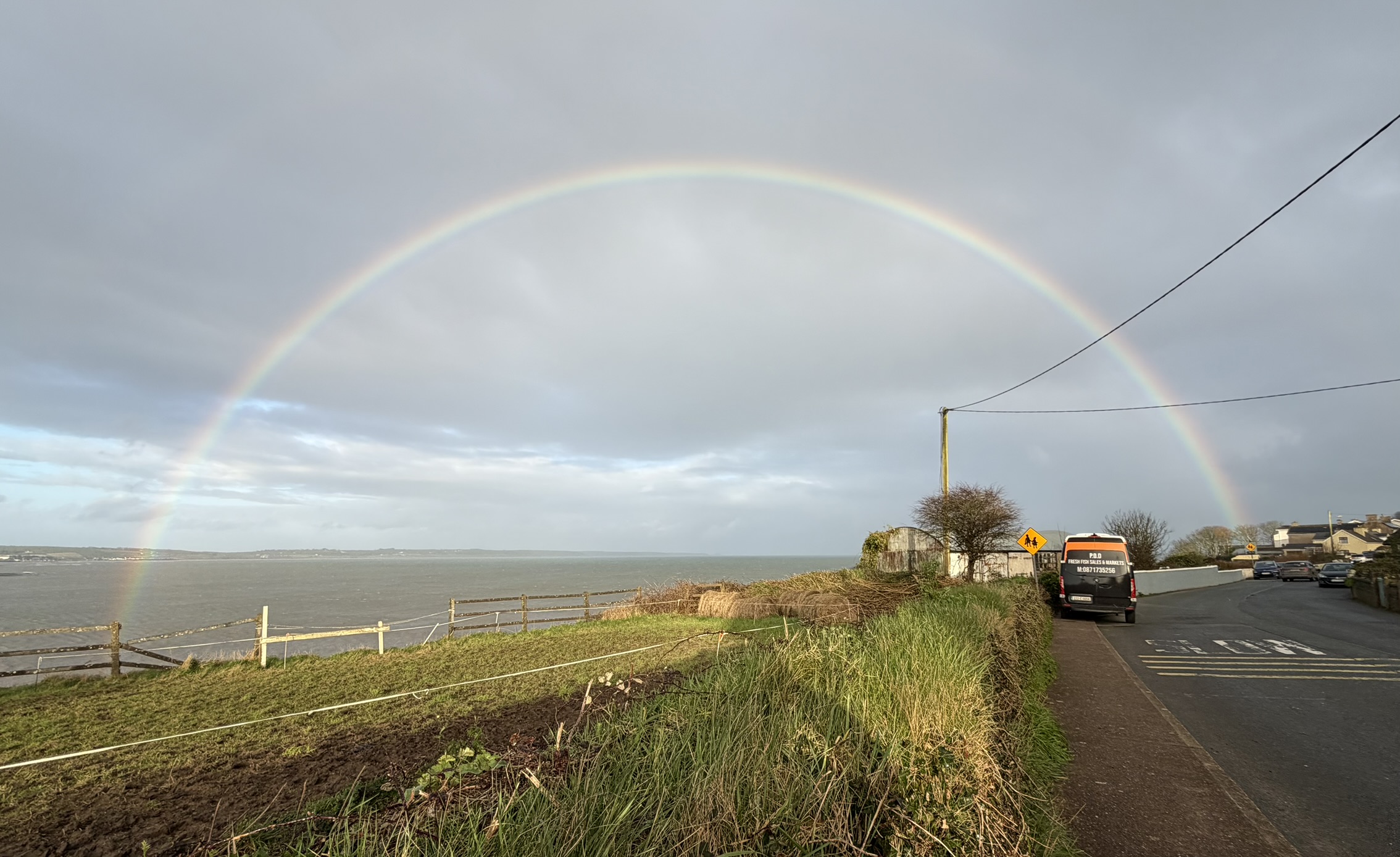
Later that afternoon, driving along the coast, the rain stopped and the sky opened. A perfect rainbow stretched across the water: the beautiful science of light bending through droplets, physics turning sunlight into color. Not generated with AI.

Technology doesn’t replace the world — it reframes it. One moment, a chatbot rebooks your flight; the next, a cook seasons soup by instinct.
Both forms of intelligence matter. But only one can taste.
Until Next Time
Stay curious. AI will change how we work, travel and plan. But water droplets and sunlight still make rainbows. And Tuesday’s red moon will rise all the same. Catch it if you can. You might just have to set your digital alarm.
Connie
P.S. A new website for Almost Intelligent is coming soon with more in-depth articles and resources. The current website, auto-generated by Beehiiv is “broken.”